Permisuan
  • Communities
  • Create Post
  • Create Community
  • heart
    Support Lemmy
  • search
    Search
  • Login
  • Sign Up
Benjamin_Kenobi@lemmy.worldM to James Webb Space Telescope@lemmy.worldEnglish · 19 days ago

Intricacies of Helix Nebula Revealed with NASA’s Webb

www.flickr.com

external-link
message-square
0
link
fedilink
1
external-link

Intricacies of Helix Nebula Revealed with NASA’s Webb

www.flickr.com

Benjamin_Kenobi@lemmy.worldM to James Webb Space Telescope@lemmy.worldEnglish · 19 days ago
message-square
0
link
fedilink
Galactic upcycling ♻️ Webb captured a new close-up of an old favorite, the Helix Nebula. We’ve seen this region before with telescopes like Hubble and the retired Spitzer Space Telescope, but Webb zooms into this dying star with a deeper, more detailed view. This image shows Webb’s view of the blistering winds of hot gas from a dying star crashing into colder shells of dust and gas that were shed earlier in the star’s life. Like oil trying to push through water, the differences in density (and speed) of the material give the nebula this incredible structure. Leftover cores of dying Sun-like stars like this one are called white dwarfs. While out of the frame, this white dwarf lies right at the heart of the nebula. Its radiation lights up the surrounding gas, creating an environment for complex molecules to form within dust clouds. This interaction is the catalyst for the raw material from which new planets may one day form in other star systems. It reminds us how stars recycle their material back into the cosmos. The iconic Helix Nebula has been imaged by many ground- and space-based observatories since it was discovered nearly two decades ago. The nebula is also a popular target of amateur astronomers and can be seen with binoculars as a ghostly, greenish cloud in the constellation Aquarius. Read more: science.nasa.gov/missions/webb/intricacies-of-helix-nebul... Credit: NASA, ESA, CSA, STScI; Image Processing: Alyssa Pagan (STScI) Image description: A closeup of a small section of the Helix Nebula, an expanding shell of gas and dust. Thousands of orange and gold comet-like pillars stream upward from the bottom, like thin liquid blown up a sheet of glass. These pillars are around the circumference of the arced shell, which forms a partial orange semi-circle at the bottom. The pillars are more numerous and denser at the bottom, and darker red. They fade to orange and then yellow in the arc. In the top two-thirds, they are thinner and more golden, and it’s easier to see the black background of space. Several bright blue stars, some with diffraction spikes, are scattered throughout. A few larger stars are on the right side.

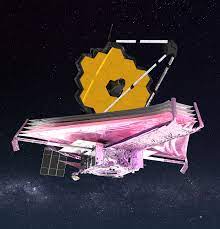
Webb captured a new close-up of an old favorite, the Helix Nebula. We’ve seen this region before with telescopes like Hubble and the retired Spitzer Space Telescope, but Webb zooms into this dying star with a deeper, more detailed view.

https://science.nasa.gov/mission/webb/multimedia/images/#Engineering-And-Test-Images

alert-triangle
You must log in or # to comment.

James Webb Space Telescope@lemmy.world

jwst@lemmy.world

Subscribe from Remote Instance

Create a post
You are not logged in. However you can subscribe from another Fediverse account, for example Lemmy or Mastodon. To do this, paste the following into the search field of your instance: !jwst@lemmy.world

A community showcasing and discussing the discoveries of the James Webb Space Telescope.

News articles, papers, journals, periodicals and of course images are welcome, as long as they’re related to the JWST. We’d also love to see your JWST inspired art work!

Please follow the link to the JWST NASA website for info: https://webb.nasa.gov/content/about/faqs/facts.html


Be respectful and inclusive. This includes being mindful of your language and avoiding personal attacks. It also means being open to different perspectives and respecting the opinions of others.

Share knowledge in a helpful and informative way. This means providing clear and concise explanations, avoiding jargon, and citing your sources. It also means being willing to help others learn and grow.

Be mindful of your audience. This means avoiding NSFW content and ensuring that all content is appropriate for all ages.

Report any inappropriate content. If you see something that violates the community rules, please report it to the moderators.

Have fun! The James Webb Space Telescope is an amazing feat of engineering, and we’re all here to learn and explore. So let’s keep the conversation positive and productive.

Here is the revised list of community rules:

Community Rules

  1. Be respectful and inclusive.

  2. Share knowledge in a helpful and informative way.

  3. Be mindful of your audience.

  4. Report any inappropriate content.

  5. Have fun!

Additional Notes

NSFW content is not allowed. This includes images, videos, or text that is sexually explicit or suggestive.

Illegal content is not allowed. This includes images, videos, or text that is illegal in any jurisdiction.

If you see something that violates the community rules, please report it to the moderators.

We reserve the right to remove any content that violates the community rules.

We hope you enjoy your time in the community!

Visibility: Public
globe

This community can be federated to other instances and be posted/commented in by their users.

  • 1 user / day
  • 9 users / week
  • 9 users / month
  • 9 users / 6 months
  • 1 local subscriber
  • 1.37K subscribers
  • 37 Posts
  • 2 Comments
  • Modlog
  • mods:
  • Benjamin_Kenobi@lemmy.world
  • BE: 0.19.15
  • Modlog
  • Instances
  • Docs
  • Code
  • join-lemmy.org