This is not completely correct though. It is our atmosphere/albedo/geological and natural processes that help maintain consistently livable temperatures, not just living in the habitable zone. No atmosphere? We’d be like the Moon, where it is too hot in sunlight and too cold in shade despite being similarly far from the sun as Earth.
If you are in space wearing space suite that doesn’t radiate heat properly, you could die from the excessive heat. Once dead your body stops producing heat and the existing heat eventually radiate away and your body freeze.
Space is neither hot or cold because these are property of matter. Since space has very little atoms, it technically has no temperature.
Can’t ignore bosons; photon wavelength is a measure of temperature too.
Space has a temperature, which is based on the average of incoming radiation through that space; i.e. the thermal equilibrium to emit as much energy as is absorbed by a theoretical perfectly thermally conductive black body at that point in space.
Based off CMB radiation, space on average is a little over 2.7 kelvin. It’ll be hotter near stars, but the void dwarfs matter on a cosmic scale


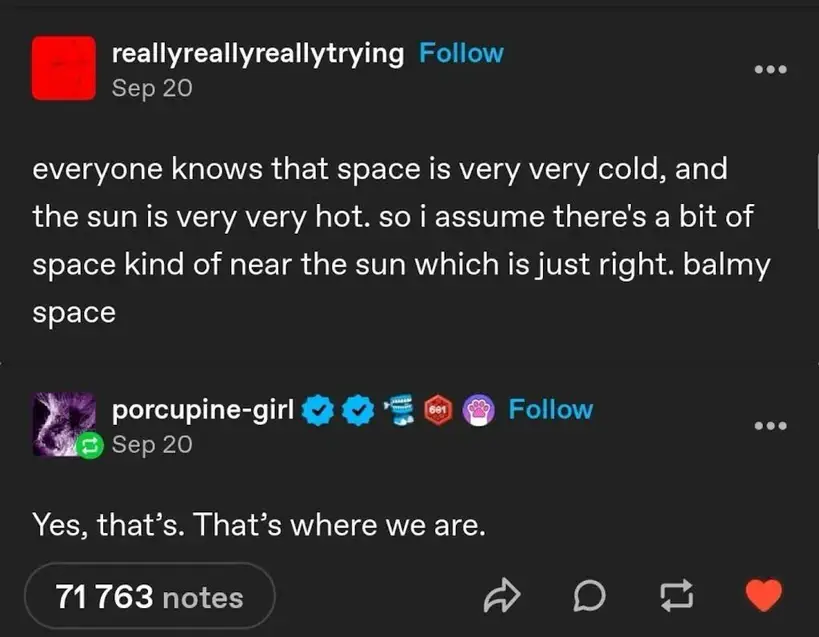
This is not completely correct though. It is our atmosphere/albedo/geological and natural processes that help maintain consistently livable temperatures, not just living in the habitable zone. No atmosphere? We’d be like the Moon, where it is too hot in sunlight and too cold in shade despite being similarly far from the sun as Earth.
Also its not true that space is “very very cold”.
If you are in space wearing space suite that doesn’t radiate heat properly, you could die from the excessive heat. Once dead your body stops producing heat and the existing heat eventually radiate away and your body freeze.
Space is neither hot or cold because these are property of matter. Since space has very little atoms, it technically has no temperature.
Can’t ignore bosons; photon wavelength is a measure of temperature too.
Space has a temperature, which is based on the average of incoming radiation through that space; i.e. the thermal equilibrium to emit as much energy as is absorbed by a theoretical perfectly thermally conductive black body at that point in space.
Based off CMB radiation, space on average is a little over 2.7 kelvin. It’ll be hotter near stars, but the void dwarfs matter on a cosmic scale