Numerous points here are untrue. The USSR’s economic growth was anything but consistent or steady, the educational and healthcare standards for the masses were subpar and the elite afforded special treatment precisely because of that reason, full employment was a myth, homelessness was a major issue, infrastructure in the SovUnion was mega-fucked, and city planning was disastrous because of the weight of the ideology and bureaucracy demanding results without being able to deliver resources.
It did not result in dramatic democratization of society, life expectancy doubled across the world average (hardly suggesting the Soviet Union’s system as the cause) in the 20th century, and the standards for who was counted as literate were reduced in the Stalinist 30s to improve the numbers.
Well, it was better than the tsarist russia. Only because even Bolsheviks would have to try really hard to make it worse (and in some aspects they managed to)
You’re right, the democratization point is utter bullshit, my bad, missed that one.
As for the other points, as I alluded to, there are caveats for many of them. On the other hand, the soviet union modernized a country that was partly a feudalist state into a superpower. While the ideology and methods are unsympathetic, many of its results were beneficial, for example health care, which though imperfect, was universal and free, unlike the US for example. Education was also free and of high quality overall, marred of course with indoctrination and ideological blinders, but still good.
Saying the USSR was all good or all bad is a naive and unnuanced analysis of 80 years of history. Compare it to tsarist Russia incredible leaps were made. Compare it to USA they outperformed them on some metrics, and underperformed on others.
I agree that the USSR was neither all good or all bad, my point was simply that many of the points raised in the screenshot are outright false, not just omissions.
I would also like to note that the semi-feudal state of the Russian Empire was itself already a major power.

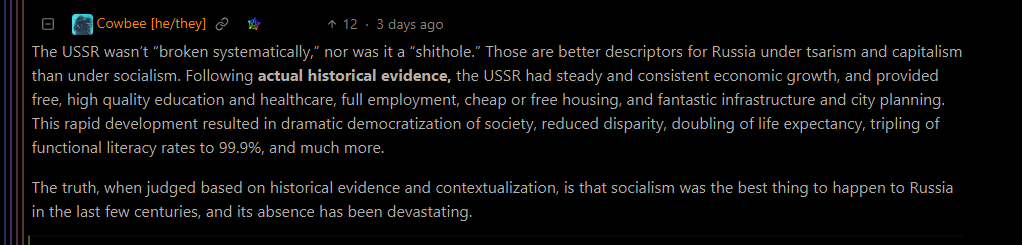
Numerous points here are untrue. The USSR’s economic growth was anything but consistent or steady, the educational and healthcare standards for the masses were subpar and the elite afforded special treatment precisely because of that reason, full employment was a myth, homelessness was a major issue, infrastructure in the SovUnion was mega-fucked, and city planning was disastrous because of the weight of the ideology and bureaucracy demanding results without being able to deliver resources.
It did not result in dramatic democratization of society, life expectancy doubled across the world average (hardly suggesting the Soviet Union’s system as the cause) in the 20th century, and the standards for who was counted as literate were reduced in the Stalinist 30s to improve the numbers.
Well, it was better than the tsarist russia. Only because even Bolsheviks would have to try really hard to make it worse (and in some aspects they managed to)
You’re right, the democratization point is utter bullshit, my bad, missed that one.
As for the other points, as I alluded to, there are caveats for many of them. On the other hand, the soviet union modernized a country that was partly a feudalist state into a superpower. While the ideology and methods are unsympathetic, many of its results were beneficial, for example health care, which though imperfect, was universal and free, unlike the US for example. Education was also free and of high quality overall, marred of course with indoctrination and ideological blinders, but still good.
Saying the USSR was all good or all bad is a naive and unnuanced analysis of 80 years of history. Compare it to tsarist Russia incredible leaps were made. Compare it to USA they outperformed them on some metrics, and underperformed on others.
I agree that the USSR was neither all good or all bad, my point was simply that many of the points raised in the screenshot are outright false, not just omissions.
I would also like to note that the semi-feudal state of the Russian Empire was itself already a major power.