
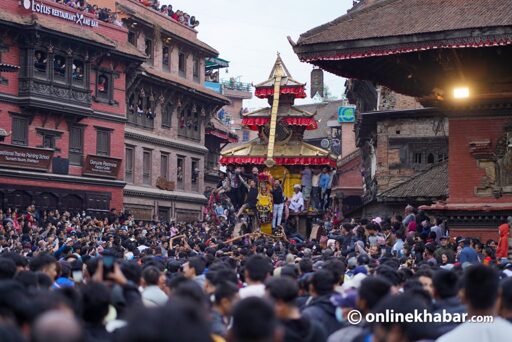
Summary:
Biska (Bisket) Jatra, a nine-day, eight-night festival in Bhaktapur with roots believed to date to the Licchavi period, began on April 10. It culminates on Baisakh 5 and includes chariot processions, ritual tug-of-war between the town’s lower (Kwone) and upper (Thane) residents, animal sacrifices, tantric rites, and ceremonial raising and lowering of the Yosin Dyo (lingo/pole).
Key events:
- Day 1: Chariot-pulling tug-of-war (Bhailakh) between Kwone and Thane; if Thane wins the chariot is pulled to Dattatreya, then returned to Ga:hiti.
- Day 2: Rest (“zero”) day.
- Day 3: Buffalo sacrifice at Bhairavnath Ga:hiti; meat distributed as prasad (“Syakwatyakwah”).
- Day 4: Erection of the ceremonial pole (Yosin Dyo) — a major ritual symbolising the old year’s farewell and the new year’s arrival; tantric rites performed in the evening; two flags (Bir Dhwaja, Bishwo Dhwaja) hung on the pole.
- Day 5 (Baisakh 1, Nepali New Year): Large gatherings at Lyasingkhel and Chupinghat; worship of Bhairav, Bhadrakali, Betal and Yosin Dyo; cock sacrifice to Betal; chariots collide in the “Sangam Jatra” (Dyo Lwakigu Jatra); Taleju (Dumaju) chariot festival observed.
- Days 6–7: Processions for Mahakali, Mahalaxmi, Brahmayani, Maheshwari and other deities; Sindoor Jatra and other local jathras.
- Day 8: Deities are placed in shrines and courtyards for “Dyo Swaga Puja” (Sagun Jatra).
- Day 9: Morning ceremonial lowering of the Yosin Dyo at Kumale Tole Talako; evening Chhuma Ganesh procession; festival ends with another tug-of-war between Thane and Kwone.
Strict security measures are enforced throughout. The festival is rich in traditional rituals, music, and community participation and is also referred to locally as an “enemy-destroying festival.”
Archive: https://archive.is/H4F2B
You must log in or # to comment.