
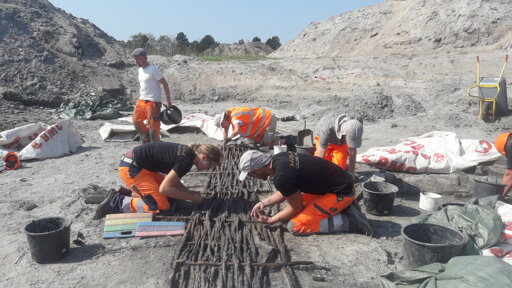
Agriculture reached the coast of southern Denmark around 4000 BCE, but these prehistoric Scandinavians continued to fish and hunt too, according to a study published in PLOS One by Daniel Groß from the Museum Lolland-Falster, Denmark, Sofie Folsach Hellerøe from Aarhus University, Denmark, and colleagues.
Abstract
This study investigates the long-term impacts of human subsistence strategies on the fauna and ecosystem of Syltholm Fjord, Denmark, from the Late Mesolithic to the Bronze Age (c. 4500–800 cal BCE). Drawing on data from 17 archaeological excavations, we examine how long-term stationary wooden fishing structures in a lagoon-like environment and terrestrial resource exploitation influenced species composition, biodiversity, and human subsistence strategies at coastal settlements on a relatively small island (c. 1200 km2). Faunal analyses reveal that while dominant fish species remained consistent across periods, terrestrial fauna exhibited shifts, particularly around 3000 cal BCE, with an increased reliance on wild game coinciding with a decline in the use of fish weirs. Diversity indices indicate a significant reduction in species richness from the Early Neolithic to the Bronze Age, suggesting a more homogeneous ecosystem potentially reflecting intensified anthropogenic influence and perhaps increased social complexity. Salinity and sediment reconstructions, together with prey choice models (PCM), highlight the persistence of aquatic resources in the diet and suggest that human foraging strategies continued to optimize energetic returns without substantially altering fishing practices. Our findings challenge the notion of an abrupt Neolithic dietary transition toward domesticates’ dominance, illustrating instead a mosaic subsistence pattern that integrates wild aquatic and terrestrial resources over millennia. The diachronic stability of the faunal composition, coupled with reduced but persistent biodiversity, implies a long-term anthropogenic shaping of the landscape, possibly linked to communal management and later hierarchical structures. This case study underscores the importance of integrating archaeological, ecological, and theoretical perspectives to understand local trajectories of human-environment interaction and social change in prehistoric southern Scandinavia.
Agreed, I wouldn’t have guessed any society would transition super quickly between food sources unless they were forced to by drought or things like that.