same with the trolley problem. it’s supposed to be so obvious, like asking someone ‘if your friend jumped off a cliff, would you?’ that it shows that it is moral to choose the lesser of two evils. it wasn’t designed to be a debate
we’re talking about the intersection between ethics and game theory though. the simple problems (trolley problem, cat dilemma, pushing a friend off a cliff, prisoner’s dilemma) have simple boring answers. It’s once you change the simple problem that it becomes interesting, both in game theory and ethics

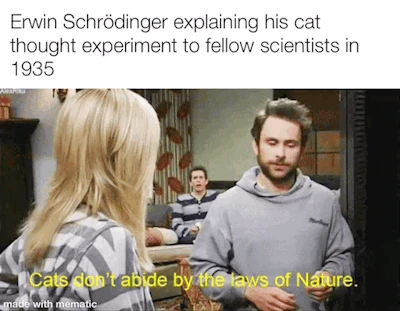
The cat thing was designed to be as absurd as possible to heckle Bohr and Heisenburg.
Similarly, Freeman Dyson’s Dyson sphere paper was a work of satire, to poke fun at how ridiculous the idea was. He got stuck with it anyway.
If Schrödinger knew that he was the modern day face of the Copenhagen interpretation, he’d be in a state of both rolling and not-rolling in his grave.
same with the trolley problem. it’s supposed to be so obvious, like asking someone ‘if your friend jumped off a cliff, would you?’ that it shows that it is moral to choose the lesser of two evils. it wasn’t designed to be a debate
we’re talking about the intersection between ethics and game theory though. the simple problems (trolley problem, cat dilemma, pushing a friend off a cliff, prisoner’s dilemma) have simple boring answers. It’s once you change the simple problem that it becomes interesting, both in game theory and ethics
Funny how our opponents can give us some of our best tools.