

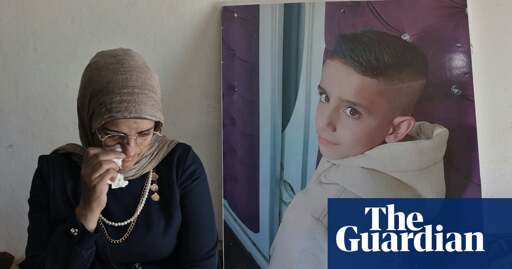
On the day he
diedwas killed, Mohammad al-Halaq had been jubilant about a new school bag he had been given in class, printed with the logo of the UN child protection and advocacy agency, Unicef.“He was extremely happy. It was something out of the ordinary for him to be given a bag,” recalled his mother, Aliyah. “He came knocking on the door to tell me had this new bag to put pencils and pens in.”
The nine-year-old ran home then raced back to school to ask, unsuccessfully, if he could get another bag for his brother. After lunch, he went outdoors to try to catch birds in a net he had rigged up. He caught one and showed it off to his friends. Full of energy, he then wanted to go to his grandparents’ house nearby.
The al-Halaq family live in ar-Rihiya, in the hills south of Hebron, which have become notorious for Israeli settler violence abetted by an increasingly politicised army. So Aliyah was nervous about Mohammad going anywhere out of her sight, but she had to go to the shops and her son was determined, waving goodbye to her as he sprinted away. It was the last time she saw him alive.
Mohammad was shot in the pelvis by an Israeli soldier at about 4pm that day, 16 October last year. He had been playing football with other boys in a school playground when two army Jeeps drove up. The boys scattered in all directions. By one account, a couple of the older teens threw stones towards the Jeeps, while others shouted at the soldiers once they had reached what they thought was a safe distance.
A video shows a soldier get out of the Jeep and aim his rifle towards the hilltop where some of the boys were watching. Shots were fired and Mohammad took a couple of steps before collapsing. Others tried to reach the bleeding boy but were held back by more shots and teargas fired by the soldiers below.
There’s plenty of accountability, look at view counts on those kill cams!