

cross-posted from: https://lemmy.ca/post/67952523
This is the first big step in the process to develop comprehensive guidelines for the Fedecan non-profit and the various platforms.
While this will mostly involve converting tacit knowledge and experience into an explicit written form, we expect that this process will inevitably bring up some points of disagreement on the best way to deal with different issues. We ask everyone participating in these discussions to please contribute constructively and in good faith. We encourage you to bring up any concerns or issues you have with the proposed structure and drafted guidelines, so that we can work together to fix them early on. However, in order to keep a productive environment for those discussions, we will be pruning any comment chains that devolve into personal attacks, slap fights, etc.
To help ground your feedback, consider these thought experiments when evaluating a potential guideline:
- Veil of ignorance: Would it still feel fair to you if you switched places with someone else on the platform (ex. a new user, a moderator, an admin, a member of a vulnerable group, etc.)?
- Equal Applicability: These rules will be enforced uniformly on everyone. A poorly written rule that helps “your side” today, can easily harm “your side” in the future as circumstances change.
The full guidelines, including governance details like the annual review cycle, can be found on the website: https://fedecan.ca/en/guidelines/
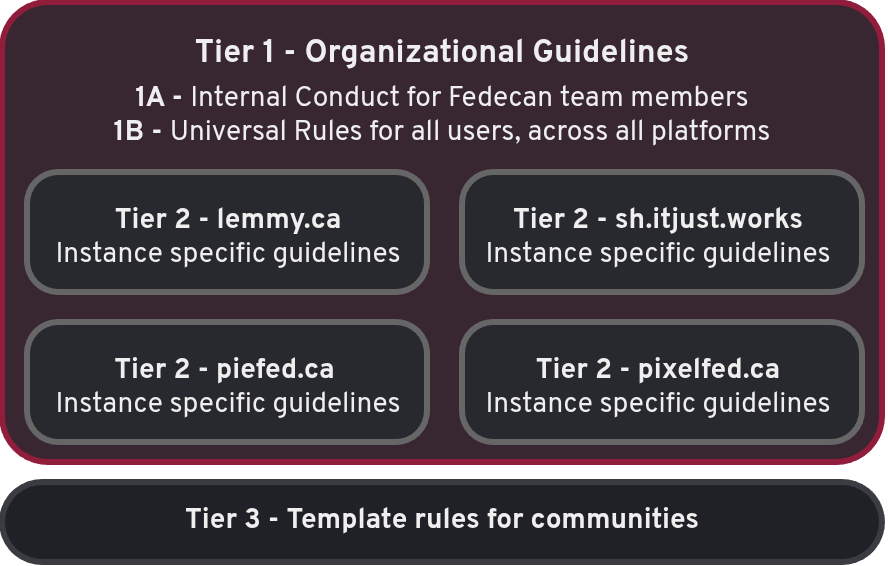
We plan to structure the guidelines as follows:
Tier 1: Fedecan Rules
Internal Conduct
These rules apply to Fedecan team members (directors, officers, admins, and anyone with elevated access). They set expectations for how team members should act.
Universal Rules
These are the baseline rules that apply to every user on every Fedecan platform. They cover the things that are prohibited by Canadian law (threats, hate speech, CSAM, non-consensual intimate imagery) as well as universal policy rules (privacy/doxxing, harassment, fraud, content that could cause harm, labelling of sensitive content, etc.).
Tier 2: Platform-Specific
Each platform has different functionality and norms, so this is where we can be more specific with the rules. The threadiverse platforms (lemmy.ca, piefed.ca, sh.itjust.works) share similar rules around community creation, moderation, vote manipulation, and content labelling. Pixelfed has its own rules tailored to its platform.
Tier 3: Community-Level Rule Templates
These are optional templates that communities can link to, or use as a starting point for their own rules. The idea is that moderators can point users to a clearly written explanation of why a rule exists, and any relevant exceptions, rather than trying to fit everything into the sidebar. Additionally, if many communities are enforcing a particular rule in the same way, then users will have an easier time understanding and following them.
The post title standards template has been drafted, and we plan to add more as the need arises. I have a few others that are in the works, but they have some overlap with the other sections, so I thought that it would be better to let people discuss first.
Thank you! That is in line with what I would have said. I’ll add on some remaining thoughts
I’ll tag @ZERONOVABLOSSOM@sh.itjust.works for the reply as well, thank you for raising the discussion about these areas. There are already some lines that I want to improve based on the discussion here.
As imaqtpie has mentioned, that bit was included because of past issues with social media platforms around those topics. I’ve also found that the culture on the Fediverse has a focus around tagging content so that it is easier for users to control their online experience, especially on the Mastodon side.
I agree with imaqtpie’s stance on those questions. While I want to wait for more discussion before proposing changes, right now I’m leaning towards separating the mental health point from the other two. Graphic content and sexual content is easy to identify, and people expect that content to be labelled. Discussion around sensitive topics might sometimes need a label, but that would be situation dependent. We could include a line to say that people can use their best judgment on when to label such content, or most it to another section entirely.
That is a good point, we can definitely do that. Maybe some expandable cards (which look like this ) with the text “What is sockpuppetry”, and a longer explanation with examples underneath. I could take from the examples @imaqtpie@sh.itjust.works shared if that would be ok?
There is likely a better term for the SEO point, but I’ll have to think of what to call it. It’s pretty obvious when it happens on Lemmy, since the account will primarily post links to the website that it is trying to promote. Before we enabled registration applications on Pixelfed.ca, we were getting a lot of accounts with bios that included links to gambling sites or sketchy online businesses.