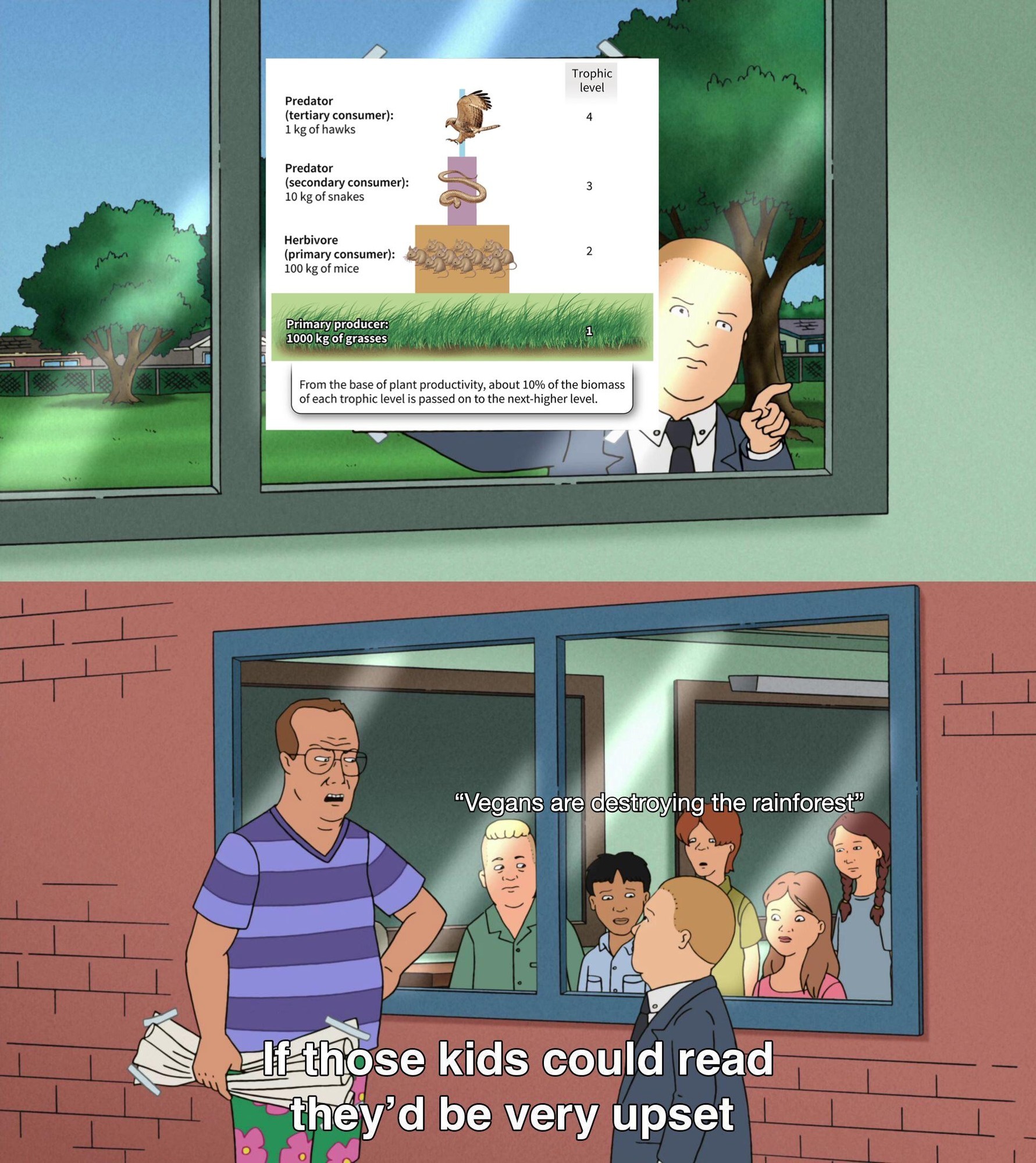

Have people said vegans are destroying forests? Thats dumb as hell
One thing I always hear is that the rainforest is killed to make room for soy agriculture. And because vegans eat a lot of soy they kill the rainforest.
That that soy is mainly used to feed animals for meat/dairy production is conveniently ignored.
is conveniently ignored
The answer to why so many animals suffer their entire life so they can be eaten afterwards.
In Brazil the forests are mostly cleared to make way for cattle or soy, and most of the soy goes to become animal food. If anything, vegans are less responsible for the deforestation than non-vegans.
Do vegans even eat that much soy?
Those gluttonous soy enjoyers!
It’s just soy good, I can’t help myself.
Honestly if I’m feeling a bit peckish and fancy a sneaky snack I’ll burn down a rainforest, grow a load of soy (…beans?), eat them, then find a gentle gorilla with eyes that reveal deep wisdom as it tearfully surveys the smouldering ruins of it’s ancient homeland and just punch the fucker in the face. If I’m feeling extra naughty I don’t even log it in my calorie counter.
You cheeky bastard!
Vegan here, no not really. The energy industry (Primary driver of soy production) and animal ag industry (Largest consumer of soy by mass) just needed a scapegoat for the subsidies and overproduction.
Not vegan per se but I eat a block of tofu a day as well as another several servings of roasted edamame most days. Like 6-8 servings per day on average
How does that compare to the average bovine?
Edit: a quick search says 2-3 pounds of soy a day.
Girl that is like so much soy 😭😭😭 you’re like the potato guy* I met but for soy
*potato guy: decided to eat only potatoes for 6 weeks, slight amount of milk and salt being a treat on the weekends. He heard that potatoes had all essential nutrients. He gave up bc he became ill in that last week. Yes he’s heterosexual.
Yes he’s heterosexual.
What does this has to do with a potato-only diet 🤣
He’s not tubersexual.
Haha yeah it’s a lot, I aim for like 150g of protein every day for strength training. The block of tofu is like 50g and the edamame is like another 40 so it just makes every other meal way easier. I definitely wouldn’t recommend eating nothing but soy tho lol. I think regardless of what you pick you’d eventually get sick if you just ate one thing.
The rest of my diet mainly consists of a lot of different bags of frozen veggies. Pretty much cycle through every type my store offers, usually pan fried, or soups in the colder months.
Oatmeal and homemade bread, a few servings of fruit each day including frozen berries and dried fruit, and on the non vegan side I have eggs, cheese, and greek yogurt. Weekends I do more fresh veggie prep as well as have “fun” foods like ice cream or whatever.
It works great for me, admittedly a lot of soy but I think that particular neuroticism of mine is actually quite tame in context; most bodybuilders pretty much do the same thing but w/ chicken breast or lean ground beef
Am vegan. Certainly don’t eat nearly as much as @Carnelian@lemmy.world. But it is a pretty flexible food. Like, I can get soy yoghurt that tastes like the real deal. I can get TVP, which is chewy like a steak. I just had fucking noodles out of 85% soy + 15% chickpeas, and they actually tasted good. And of course, the all-time classic: Soy sauce.
I don’t stan for soy nearly as much as many others, because other legumes and nuts are awesome, too, but you just can’t deny that soy covers a lot of bases quite well.
Shouldn’t be a surprise, that some people are dumb as hell.
I doubt it’s that high. US grows a ridiculous amount of corn on perverse incentives, only 1.5% of it is edible. Most soy is not eaten, it’s processed for oils.
Notice the meat industry apologetics misusing the words like they misuse the lands.
This is looking at global data. Most countries are a lot less wasteful than the US. It also completely disregards waste food, though it says it only makes up 5% of global caloric production.
According to the article, the US produces 14% of all agricultural calories on Earth. 28% of this is spent on non-food purposes, while 17% is spent on food but not animal feed, compared to 15% and 45% globally. This means that while the US produces twice as much calories per acre of farmland than the global average, it can actually feed fewer people per acre than average.
The article is all cropland, not just corn. So it includes things like wheat production in the western great plains, fruit and vegetables in the Imperial and Central Valleys in California, apple farms in Washington and Michigan, oranges in Florida and California. But you are correct that most corn, soy, and alfalfa are grown for non-human consumption
soy is primarily grown for human consumption. over 4/5 of the global crop is sent to an oil press.
Do you have any source for that? In the ones I found, it’s more like 4/5 of the soy grown for human consumption is for oil, but human consumption is only 1/5 of the production.
See e.g. here https://ourworldindata.org/drivers-of-deforestation#is-our-appetite-for-soy-driving-deforestation-in-the-amazon, the oil production uses 13.2% of the global soy.
the paper says 49% goes to humans, and 52% goes to oil and animal feed… so something doesn’t add up
What they fail to mention is that crops are usually graded with best to mid quality going to humans and low quality going to other purposes like animal feed.
Even without that culling, half the calories are not calories humans can process. We can’t digest stalks of corn or wheat, for example. Various livestock animals can digest biomass that would otherwise go to waste.
And it can also be used to make ethanol.
There’s actually very little waste in agriculture, and even in ranching. Hell, cows that die in the field of natural causes can still be 100% processed.
There’s little waste in food production in general, even animals are completely used in meat processing.
I can’t seem to find the full paper
thank you.
It’s easier to make fun of people then to engage with them, because engagement requires honest intellectual rigor
where is the full paper?
https://iopscience.iop.org/article/10.1088/2976-601X/ae4f6b/pdf PDF (link to web under the image)