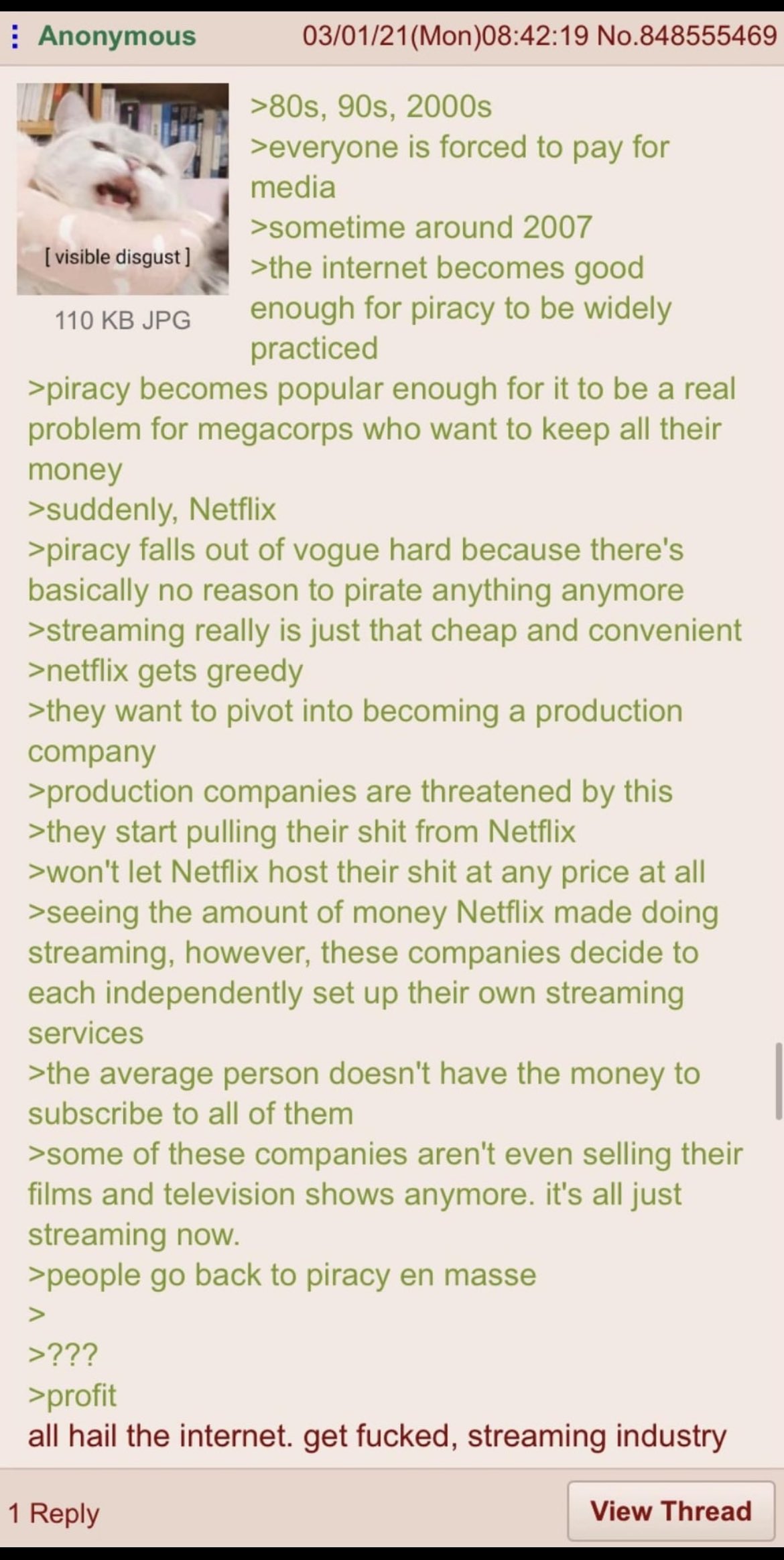

Anon got it backwards, networks noticed how profitable Netflix was and bumped the price for Netflix to stream their stuff. Netflix responded by producing their own content rather than leasing others’ at exorbitant rates. Then Netflix later got greedy and bumped their prices, lowered their quality, and cancelled all of their good shows.
I think it’s a bit of both. Netflix knew that companies choosing to pull their content would be a threat, so they prematurely started producing content (famously starting with House of Cards and Orange is the New Black). Whether because they saw this as a threat or because of the perceived greater profitability of their own platforms (probably a bit of both), other studios started pulling their content from Netflix and setting up their own streaming sites.
And naturally, other companies pulling their content accelerated Netflix’s desire to produce their own content to ensure they weren’t left in the lurch.
Yall are overcomplicating things. Let me simplify.
Capitalist corporations + infinite greed = cannibalism
I feel like people are ignoring that Netflix was bleeding money during their “golden age”. They only switched to being profitable a couple years back. A lot of times what people describe as enshittification is just unprofitable companies having to come up with an actual business model as venture capital dries up.
Also, merry Christmas:)
You can also argue that silicon valley has that particular business model of purposely making a product look great and cheap until enough people sign up.
It’s distinct from how most companies run in the red at their inception in that those traditional businesses would gladly be in the black but are waiting for economies of scale or building a reputation among consumers.